Friday, May 31, 2013

Flood of 2013?

How ironic that as we near the 5 year anniversary of the 2008 flood, the Cedar river is once again rising.

It's not expected to reach the record high level of 31 feet--the height of the river in 2008.

(Awesome picture of the 2008 flood from boston.com)

The predicted crest is 19.9, which is 7 feet above flood level, still far below 2008's crest.

Plus, this time, the city knows what to do.

I was in the New Bo neighborhood yesterday.  It's right across the river from Czech town, around the intersection of 12th Ave. SE and 3rd St. SE.  As we sat in Brewed Cafe, we watched the activity--trucks going by with sand, sandbags being filled over by the market, and, inside the Cafe, boxes being brought up from the basement and moved to the 2nd floor.

 This last picture, below, is a concrete cylinder and sandbags placed over a storm sewer.  We saw that all over New Bo.  They're making sure the water doesn't come OUT of the storm sewers into the neighborhood.

New Bo should be OK if the flood really does crest at 19.9 feet.  But, of course, it might go higher, depending on rain here and upstream.

How do I know this?  Well, I've been fiddling around with the Iowa Flood Center's website, which shows where flooding will occur at different river stages. I wrote a story about it for the Gazette a couple years ago. Here's what it looks like:
If you want to visit the site, you can find it at http://ifis.iowafloodcenter.org/ifis/main/?m=Cedar_Rapids

If you visit the site, you can move the little "Flood Map Controller" lever (on the right side) to match the expected crest and see where flooding will happen.  Move it up to 31 feet and see what we got in 2008  . . .

Anyway, Robbie and I were curious about what things looked like, so we rode our bikes down across the river.  The water was way up on the bridges, as you can see from this picture a friend posted on Facebook.  It was at about 17 feet, according to a marker on the side of one of the bridges, still 2.9 feet short of its future crest.

Then we rode out along 1st Street NW.  There's a bike trail that goes along the top of the levee, with great views of the river.  The levee was doing its job--no water in that area!  But it only goes to Penn Street, and after that, well . . . the river was moving in.

Down by the waterski bleachers, which were flooded, the road was closed, and so was the bike trail.

On the way back, I noticed that the river is higher than the road--the levee is doing its job.

The crest is supposed to be on Saturday evening.  Things are pretty dry now--in Cedar Rapids and upstream.  Maybe 19.9 feet will be our final flood stage.

Monday, April 22, 2013

Confusing Spring Wildflowers

I met only one other person walking at Palisades State Park today just as I was leaving.  He said "Lots of pretty flowers out today."  I agreed.  "Yes, the woods are full of them!"

I almost said "Yes, the hepatica are in bloom, and so are the bloodroots!"  But I stopped myself--didn't want to sound like a flower geek.

Really, though, it took me until the end of my walk to realize that those flowers WERE hepatica.  Every year I get confused by them.

They look a little bit like spring beauties, another one of the spring ephemerals (wildflowers that appear in the spring, and completely die back after they bloom), and they confuse people.  When my friend Nancy, who works at the Nature Center, told me that people were telling her that spring beauties were in bloom, I knew that they couldn't be right.  Spring beauties are a bit later, even in a warm year.  Here are some spring beauties.

They have leaves like grass stems, and the flowers look like Candy-Stripers.

The reason I didn't figure out the hepatica right away was that they didn't have leaves.

The hepatica leaves are distinctive three-lobed, mottled leaves that supposedly bear resemblance to a liver (early settlers used hepatica to treat liver ailments).  At first, I saw NO leaves with these flowers.  But then I found a plant with a few leaves.

The drought and subsequent hard winter must have caused the leaves to shrivel back.  Usually, they're somewhat evergreen.

There were a few bloodroot abloom, too.  Bloodroot are striking flowers--bright white with bright yellow stamens.  They bloom singly, not in a clump like hepatica, and with a single leaf wrapped around the stem.

I used to have both bloodroot and hepatica in my shade garden, but I think the drought and hard winter killed them off.

The pants were just starting to bloom.  I'll have to go back for a better view of them.

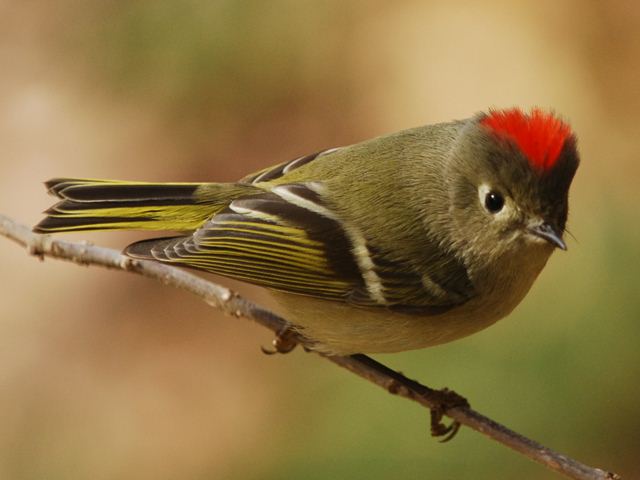
Besides the flowers, I had a nice conversation with a ruby-crowned kinglet.  I spotted it in a tree far away, and wasn't sure of what it was--its song/calls seemed familiar.

I stood there thinking that I wished I'd brought my binocs.

Then I tried to lure it closer by pssshing.  The bird flew right over!  It hopped around in the low-hanging tree branches over my head, cocking its head back and forth to get a good look at me.  I got a good look at it, and was able, with the help of my Peterson's Guide app on my iPod, to identify it.  Definitely a ruby-crowned kinglet!


Such a cute bird! And so bold!  (I had to borrow this picture from the Carolina Bird Club's website as I didn't have a good camera for birds.)

I spotted a couple more on my walk, and was able to lure them closer by pssshing!

Why was I out walking on a Monday morning in April?  It was Flunk Day at Coe.  Great day for a spring ephemerals walk!

Tuesday, March 26, 2013

Playing games


Robbie and I have been enjoying a new game this winter: Carcassonne.  It is, according to the box, "a simple, clever tile laying game, that brings new challenges with every turn."

It's made by a German company (hence the slightly odd wording), and won Spiel des Jahres 2001. A clerk in our new indie bookstore in town, New Bo Books, told me about it and I was intrigued. It ended up under our Christmas tree this year.

Basically, players take turn drawing tiles, and put together a medieval landscape with them, placing "men" on the tiles in order to get points.  


OK, confession:  I bought it as a ruse. It's to get Robbie to sit and do something with me. He'll even stop fiddling with digital art tutorials on his new laptop in order to play a game of Carcassonne with me, which pleases me.

In the past, I've bought other games for the very purpose of tricking him into spending time with me.  I love to lose to him in Bananagrams and Boggle; anything to get him to hang out with me on a winter's evening.

The kitty usually joins us in her usual way:  first she walks across the playing field, then she sits at the edge of the rug with her back to us.
Act interested, but not too interested.  And stay in the vicinity of the people you love.  As the mom of teenage boys, I can relate to her approach.

Wednesday, March 20, 2013

An e-world

Meeting with one of my students yesterday, I asked her about a project she was working on for the class.  Was she going to create a Facebook page or a Twitter account for her class project?

"I think Twitter," she said. "It's kind of a Twitter world these days."

Is it?

I'm not even sure I'm completely happy about a Facebook world.

As a writing professor, I feel I need to stay current with the various platforms that people are using to write.  Blogs make sense to me, and I've gotten used to Facebook.  But sometimes when I'm confronted with all the others--Twitter, Tumblr, Instagram, Pinterest--I start to lose interest.

Still, I like the idea of multimedia essays: writing that also incorporates images, links, maybe even audio. That's how I view blogs.  My Titanic blog, Reading the Titanic, is kind of a one-month-long multimedia essay.

I had my students do a bit of multimedia today.  They were to create multimedia pages about an E.B. White essay.  Here's one I created as a sample.

I hope it was useful--for getting them to think creatively about a subject, to get them thinking of multimedia.

I wonder what E.B. White would think about multimedia essays . . . .

Monday, March 4, 2013

A casino in our town?

When Bruce and I visited Cedar Rapids back in 1989 for his interview at Coe, I was amused by the way people described the city to us.  "It's a great place to raise a family," was the constant refrain--usually directed at me.  We weren't yet married, and I was planning on going to graduate school, so I found the constant focus on family life a bit odd.

Once we moved here, I began to discover the character of this town.  OK, yes, it is a nice place to raise a family.  The schools are good, housing is reasonably priced, there is plenty for young families to do.  But as a  person without young kids, I noticed other things.

Like the fact that Cedar Rapids has its own symphony orchestra that plays in a beautiful venue.  It has a great public library.  There are lovely, walkable neighborhoods. There is a minor-league baseball team that plays from April through August, and farmer's markets somewhere in the area every day during the summer.

Cedar Rapids is a city that provides opportunities for residents to enjoy cultural and recreational activities in the company of their neighbors.

And that flood of 2008?  It showed the city's character growing and changing as city residents turned out to help each other in times of disaster.  That growth and change in our city's character seems permanent--it's evident in the new Matthew 25 ministries in the Time Check neighborhood that flourishes even after the flood.

I am wondering, these days, how the character of my new hometown will change in the upcoming year or so.  This Tuesday, we are voting on whether we want to have a casino in our downtown.

I think it is awesome that we get to vote on this matter--it's so democratic!  The casino will be a private business, but our state has decided that the people in the city get to decide whether we want it or not.

That's because a casino is not the usual kind of business. It's a business that can be considered illegal if not done correctly. It doesn't make things.  It doesn't provide services.  Casino owners would say it provides entertainment, but I'm not sure.  Is a casino entertaining all the time, or just when you win?

A casino makes money because people mostly lose their money. And it makes a lot of money on people who can least afford to be "entertained" in that way.  Even the "gaming" industry's affiliated charity, the National Center for Responsible Gaming, says that 5-15% of gambling profits come from problem gamblers; other organizations put the figure at 30-50%.  I imagine it's somewhere in between.

Everyone agrees that people with lower incomes spend a larger percent of their money in casinos than wealthier people do.

I've never been to a casino. But occasionally, the local news shows video clips from inside our Midwest casinos--now located throughout Iowa.

Casinos in movies are filled with young, wealthy-looking extras wearing tuxes and slinky gowns.

The real casinos here in the Midwest are filled with ordinary people (mostly older folks), smoking and yanking on one-armed bandits.  They look rather unhappy, even when showers of coins pour out of the machines.

The coins go back into the machines.  I guess that's what we want to happen.  That's what creates jobs in this kind of business:  persuading people they're going to win, when they're really going to lose.  Yes, Cedar Rapids will gain some tax revenues.  Yes, there will be some money given to some local organizations.  But is this the way we want to get it?

The way I see it, Cedar Rapids has a chance on March 5, to determine the direction that its character will grow.  Do the residents of Cedar Rapids want to live in the kind of city that wants a casino?   I don't.

Wednesday, February 27, 2013

A writer with a camera


I love being a freelance writer.  Besides the coolness of that job title, I get to do a lot of really awesome things, the most awesome of which is meeting interesting people and asking them lots of questions.  I love doing that.  Making stories out of the answers is pretty cool.

Sometimes I do more than ask questions.  I did two food-oriented profiles recently--on a cupcake bakery and a homestyle Italian restaurant--and I got to taste some of the food.

Yesterday I finished up a story—just in time to meet deadline—but I hadn’t yet found a picture, and my editor said she wanted at least one.

One of my sources said he might have some on his website, but they were too small for a print publication.  I tried calling his office to see if I could come down and get some photos, but his office manager wasn’t encouraging.  She actually kind of put me off the idea.

So I asked my editor for an extension to give me time to come up with some photos.   Wondered what I’d do.

An idea slowly came to me.  I had to go out to the drug store to pick up some milk anyway.  Maybe I could get a photo there. . . . 

Me (to pharmacist):  Hi.  Um, I have a strange request.  I’m a freelance writer for the Gazette and need a photo for a story I’m writing about colonoscopies for National Colon Cancer Awareness month, and I wondered if I could borrow a bottle of colonoscopy prep solution just for a picture.

Pharmacist:  (looks at the other pharmacist)  I suppose that would be OK.  You don’t need to take it out of the store, do you?

Other Pharmacist:  (with a grin) Do we have to be in the picture?

Me:  No—I’ll take it here.  I have this cart with supplies that someone might need to prepare for a colonoscopy. And you can be in the picture if you want to!

Pharmacist:  My last year’s physical was before I turned 50.  I think this year, my doctor’s going to tell me to get a colonoscopy.

Me:  Yes, he probably will.  I had one—it’s no big deal.


Tuesday, February 5, 2013

Missing Moby Dick


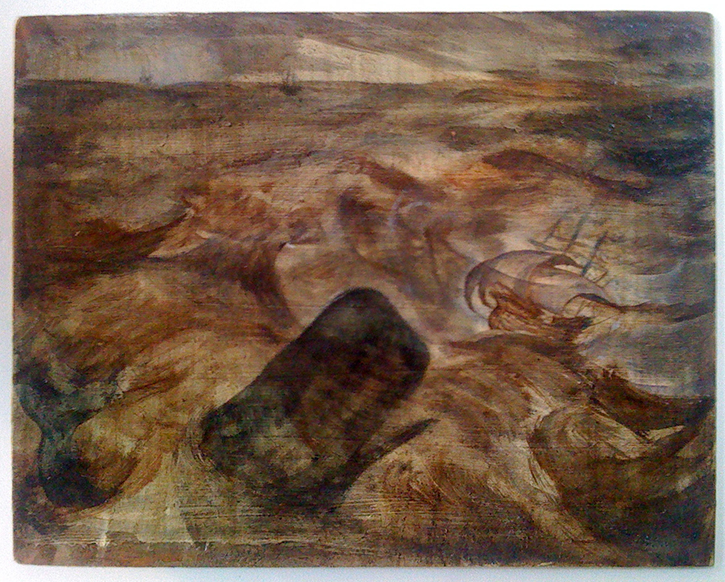
On these recent cold winter evenings, I find myself thinking about Moby Dick.

This fall and winter, I read one chapter a night, and in that way finally finished the book, all 135 chapters of it.

I was inspired by the Moby Dick Big Read, which I read about in the newspaper and heard about on NPR. At first, I didn't take the bait.  I'd tried reading Moby Dick several times before and always got bogged down even before they left the shore.  That endless ridiculous  scene at the inn, with Queequeg and Ishmael--that just stopped me in my tracks.  In fact, I eventually owned my inability to finish the book, laughing with some friends at a graduate school gathering about being part of a "No Mobys" club--people who'd never read the book.

Let me remind you that I was at graduate school studying English, so probably I shouldn't have been proud.

But then sometime this fall my brother told me he was downloading the podcasts on the Big Read site, and my friend Carol told me she was reading it. "Just one chapter a night, that's all," she told me.

Well, I could do that.  And so I started.  I downloaded the book on my new Kindle and began reading on September 21.

Not only did I get past my usual stopping point at the Spouter Inn . . . I began to enjoy reading.  Once they were out on the ocean, I sometimes had trouble stopping after one chapter at a time.  And I finished the book on January 20.

Last week, my friend Lisa and I were talking about Moby Dick.  She remembers Garrison Keillor talking disparagingly of Moby Dick once, and she was put out.  "It's a wonderful book," she said.  "It has some of the best American writing about nature!"  I agreed, and we talked about some passages we loved.

So if you're like me, and don't think you'd ever read Moby Dick, I encourage you to open your heart to The Whale!
Here are some things that are really cool about it:
  • It has some great nonfiction writing--some chapters shared lively information about life on a sailing ship in the 19th century--how the ship was run, how the people worked together, how they went out in the whaling boats.  
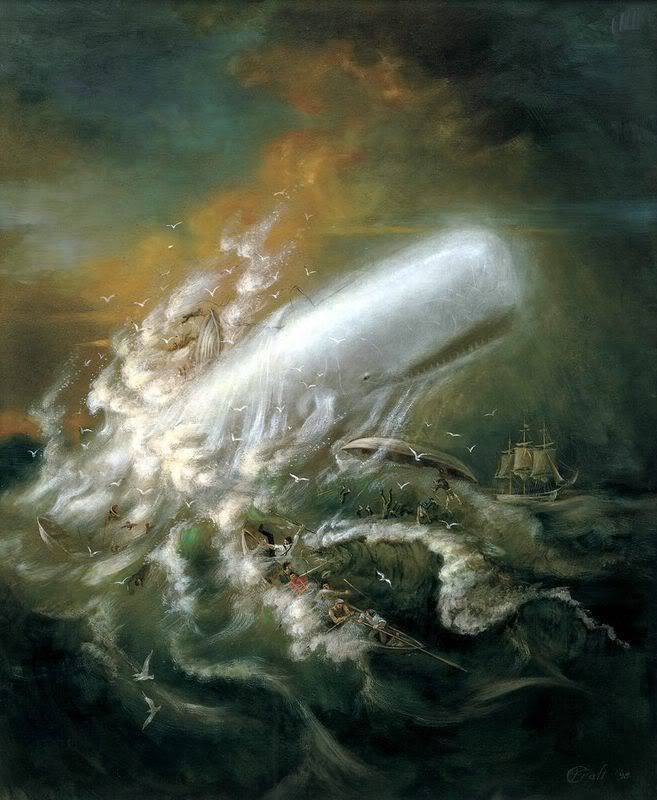
  • I also loved his chapters about the whales themselves, classifying the whales into "folios" by size:   I.  The Sperm Whale; II.  The Right Whale; III The Fin Back Whale . . .  The descriptions of each type of whale were so interesting that I had to look up pictures.  Here's one Melville might have looked at:

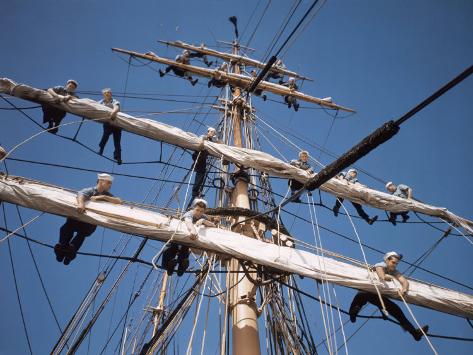
  • Ishmael's description of being up in the rigging might make you want to go to sea!:
"lulled into such an opium-like listlessness of vacant, unconscious reverie is this absent-minded youth by the blending cadence of waves with thoughts, that at last he loses his identity; takes the mystic ocean at his feet for the visible image of that deep, blue, bottomless soul, pervading mankind and nature . . ."

  • When Ishmael and his fellow sailors were out hunting whales, they found themselves in the midst of a whale nursery.  Mother and child whales came right up to the boats.  The passage is so touching.  
". . . we were now in that enchanted calm which they say lurks at the heart of every commotion. . . these \smaller whales--now and then visiting our becalmed boat from the margin of the lake--evinced a wondrous fearlessness and confidence . . .  like household dogs they came snuffling round us, right up to our gunwales, and touching them; till it almost seemed that some spell had suddenly domesticated them.  Queequeg patted their foreheads. . . "


  • Almost impossible to read were the chapters about the whale hunt in the middle of the book.  I think Melville meant them to be awful:
"the red tide now poured from all sides of the monster like brooks down a hill.  His tormented body rolled not in brine but in blood, which bubbled and seethed for furlongs behind in their wake."
and
"It was most piteous, that last expiring spout."

Poor whale.
  • There are several moving stories about tragedies that have happened aboard passing ships.  What a story about the ship called The Rachel--the captain's young son had gone out on a whaling boat and the boat had been dragged out to see and lost.
  • OK, that last few chapters when Ahab hunts Moby Dick . . . those are pretty awesome! And I had to read that very last chapter several times--WOW!

Maybe the best way to read this book is a chapter at a time.  It's long and gives one a lot to think about.  And I have to admit, I skimmed over the parts where Ahab goes on and on in stilted oratorical language . . . blah.  Ahab's not the heart of this book; the ocean is, and whales.

Of course, my friend Wendy (a Victorian scholar and feminist) points out that Moby Dick has everything in it . . . except women!  So after you read Moby Dick, or before you do, I recommend  Ahab's Wife.