Wednesday, February 27, 2013

A writer with a camera


I love being a freelance writer.  Besides the coolness of that job title, I get to do a lot of really awesome things, the most awesome of which is meeting interesting people and asking them lots of questions.  I love doing that.  Making stories out of the answers is pretty cool.

Sometimes I do more than ask questions.  I did two food-oriented profiles recently--on a cupcake bakery and a homestyle Italian restaurant--and I got to taste some of the food.

Yesterday I finished up a story—just in time to meet deadline—but I hadn’t yet found a picture, and my editor said she wanted at least one.

One of my sources said he might have some on his website, but they were too small for a print publication.  I tried calling his office to see if I could come down and get some photos, but his office manager wasn’t encouraging.  She actually kind of put me off the idea.

So I asked my editor for an extension to give me time to come up with some photos.   Wondered what I’d do.

An idea slowly came to me.  I had to go out to the drug store to pick up some milk anyway.  Maybe I could get a photo there. . . . 

Me (to pharmacist):  Hi.  Um, I have a strange request.  I’m a freelance writer for the Gazette and need a photo for a story I’m writing about colonoscopies for National Colon Cancer Awareness month, and I wondered if I could borrow a bottle of colonoscopy prep solution just for a picture.

Pharmacist:  (looks at the other pharmacist)  I suppose that would be OK.  You don’t need to take it out of the store, do you?

Other Pharmacist:  (with a grin) Do we have to be in the picture?

Me:  No—I’ll take it here.  I have this cart with supplies that someone might need to prepare for a colonoscopy. And you can be in the picture if you want to!

Pharmacist:  My last year’s physical was before I turned 50.  I think this year, my doctor’s going to tell me to get a colonoscopy.

Me:  Yes, he probably will.  I had one—it’s no big deal.


Tuesday, February 5, 2013

Missing Moby Dick


On these recent cold winter evenings, I find myself thinking about Moby Dick.

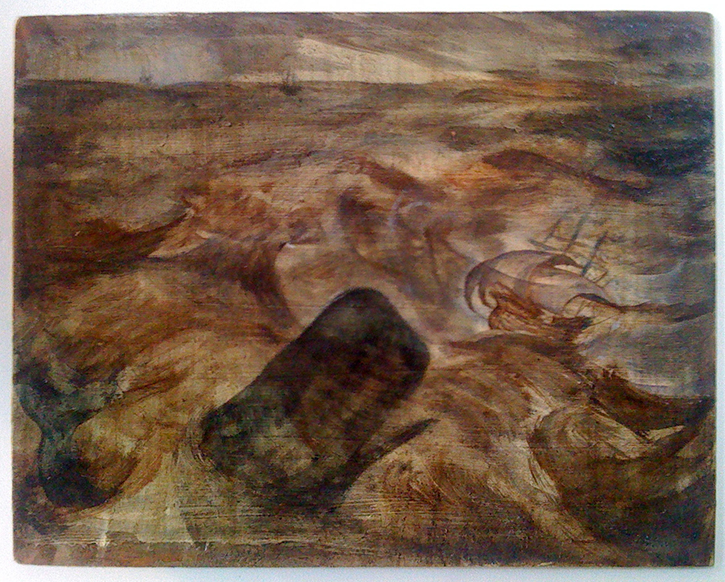
This fall and winter, I read one chapter a night, and in that way finally finished the book, all 135 chapters of it.

I was inspired by the Moby Dick Big Read, which I read about in the newspaper and heard about on NPR. At first, I didn't take the bait.  I'd tried reading Moby Dick several times before and always got bogged down even before they left the shore.  That endless ridiculous  scene at the inn, with Queequeg and Ishmael--that just stopped me in my tracks.  In fact, I eventually owned my inability to finish the book, laughing with some friends at a graduate school gathering about being part of a "No Mobys" club--people who'd never read the book.

Let me remind you that I was at graduate school studying English, so probably I shouldn't have been proud.

But then sometime this fall my brother told me he was downloading the podcasts on the Big Read site, and my friend Carol told me she was reading it. "Just one chapter a night, that's all," she told me.

Well, I could do that.  And so I started.  I downloaded the book on my new Kindle and began reading on September 21.

Not only did I get past my usual stopping point at the Spouter Inn . . . I began to enjoy reading.  Once they were out on the ocean, I sometimes had trouble stopping after one chapter at a time.  And I finished the book on January 20.

Last week, my friend Lisa and I were talking about Moby Dick.  She remembers Garrison Keillor talking disparagingly of Moby Dick once, and she was put out.  "It's a wonderful book," she said.  "It has some of the best American writing about nature!"  I agreed, and we talked about some passages we loved.

So if you're like me, and don't think you'd ever read Moby Dick, I encourage you to open your heart to The Whale!
Here are some things that are really cool about it:
  • It has some great nonfiction writing--some chapters shared lively information about life on a sailing ship in the 19th century--how the ship was run, how the people worked together, how they went out in the whaling boats.  
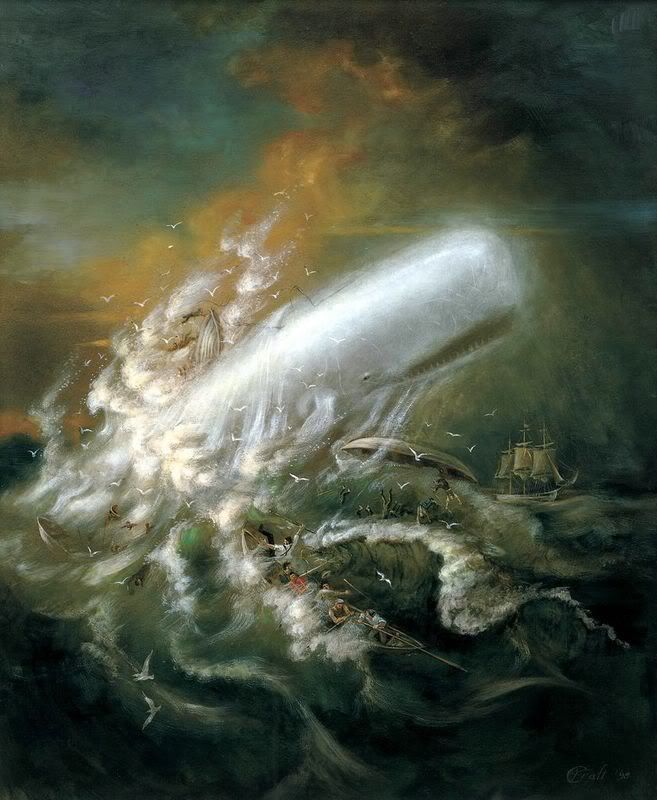
  • I also loved his chapters about the whales themselves, classifying the whales into "folios" by size:   I.  The Sperm Whale; II.  The Right Whale; III The Fin Back Whale . . .  The descriptions of each type of whale were so interesting that I had to look up pictures.  Here's one Melville might have looked at:

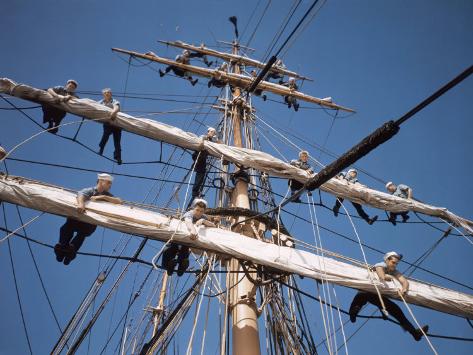
  • Ishmael's description of being up in the rigging might make you want to go to sea!:
"lulled into such an opium-like listlessness of vacant, unconscious reverie is this absent-minded youth by the blending cadence of waves with thoughts, that at last he loses his identity; takes the mystic ocean at his feet for the visible image of that deep, blue, bottomless soul, pervading mankind and nature . . ."

  • When Ishmael and his fellow sailors were out hunting whales, they found themselves in the midst of a whale nursery.  Mother and child whales came right up to the boats.  The passage is so touching.  
". . . we were now in that enchanted calm which they say lurks at the heart of every commotion. . . these \smaller whales--now and then visiting our becalmed boat from the margin of the lake--evinced a wondrous fearlessness and confidence . . .  like household dogs they came snuffling round us, right up to our gunwales, and touching them; till it almost seemed that some spell had suddenly domesticated them.  Queequeg patted their foreheads. . . "


  • Almost impossible to read were the chapters about the whale hunt in the middle of the book.  I think Melville meant them to be awful:
"the red tide now poured from all sides of the monster like brooks down a hill.  His tormented body rolled not in brine but in blood, which bubbled and seethed for furlongs behind in their wake."
and
"It was most piteous, that last expiring spout."

Poor whale.
  • There are several moving stories about tragedies that have happened aboard passing ships.  What a story about the ship called The Rachel--the captain's young son had gone out on a whaling boat and the boat had been dragged out to see and lost.
  • OK, that last few chapters when Ahab hunts Moby Dick . . . those are pretty awesome! And I had to read that very last chapter several times--WOW!

Maybe the best way to read this book is a chapter at a time.  It's long and gives one a lot to think about.  And I have to admit, I skimmed over the parts where Ahab goes on and on in stilted oratorical language . . . blah.  Ahab's not the heart of this book; the ocean is, and whales.

Of course, my friend Wendy (a Victorian scholar and feminist) points out that Moby Dick has everything in it . . . except women!  So after you read Moby Dick, or before you do, I recommend  Ahab's Wife.

Thursday, January 31, 2013

Names for Snow

Recently, the old saying that Eskimos have a thousand names for snow has been proven false.  Still, it seems like there should be more names for snow than just "snow."

I'm no Eskimo, but I've lived in northern, snowy areas all my life.  It seems to me that our vocabulary should be enlarged to include words that describe

Big, fat Potato-Chip snow.  This is the kind of snow I remember from when I was growing up in suburban Cleveland. Winters were cloudy and snowy, somewhat damp. And the snow was inevitably fat flakes.  I understand now that they are actually many individual snowflakes all clumped together.

The thing about these snowflakes is their laziness.  They float gently down.  This does not mean that they aren't serious.  When it's snowing like this, the snow can accumulate very quickly.

I remember watching Potato-Chip snowflakes through the window of a lawyer's office the winter my parents died.  We were meeting with the lawyer to talk about my parents' estate, and the talk got thick with lawyerese as the skies outside got thick with snowflakes.  Eventually, I stopped trying to follow the conversation and just watched the snowflakes.  I was still wondering how, if my dad was gone, the world could keep going.

We don't get Potato-Chip snow here in Iowa very often.  We get Iowa snow.  There are a few varieties.

Lint snow.  This is the kind of snow that appears in the air when a cold front is squeezing what little moisture there is out of the air.  Lint snow is like dust--it floats around in the air, and doesn't really accumulate on the ground.  Usually when there's lint snow, it's very dry, very cold.  Eventually, there'll be enough that the lint snow will swirl around on the streets.

Lint snow is very frustrating.  It's cold.  It's cold enough to snow--but there's not enough moisture to get the snow.  It makes my boys mad--they aren't getting snow for sledding, for shoveling (they have a shoveling gig for money), or for the schools to close.

Serious snow.  Occasionally, we'll get lucky here in Iowa, and moisture will collide with a cold front to bring us snow.  Serious snow is what we usually get.  Serious snow isn't nearly as attractive as Potato-Chip snow--it's got smaller flakes.  And it's less friendly, too--usually it's carried along by gusts of wind that make it seems like it's falling sideways.  When the wind stops gusting, Serious Snow falls straight down, not floating in any kind of picturesque way. Often when it's snowing, you can't see through it.

When we get a couple hours of serious snow, it can accumulate pretty well.  It can also be pretty heavy and not very fun to shovel.  Despite its heaviness, it's not good for making snowmen.  It is, however, pretty nice for sledding.

After Serious Snow has been on the ground for a while, it becomes Blowing and Drifting snow.  Blowing and Drifting snow is a big Iowa hazard.  Because our snow has such tiny, dry flakes, it doesn't stick together or stay on the ground very well.  The wind just picks it up and sweeps it around.  Drifts form everywhere, even in paths shoveled along the sidewalk.  If you walk past buildings, Blowing and Drifting snow goes down your neck.  It snakes across roads in an eerie way when the winds are high.

Usually after a snowstorm, we got Bitter Cold.  Like today, Bitter Cold, with temperatures down to 30 below zero, is accompanied by bright, sunny skies.  Eventually, the wind dies down.  It's dry and biting outside, and your breath freezes inside your nose.  It makes your shoulders hunch up and eyes squint.  That dry Bitter Cold also dries out the snow so that it becomes Styrofoam snow, crusty and brittle, with all the moisture sucked out.  Often it gets dirty, too.  Sometimes I wish for a thaw so we can get rid of the old Styrofoam snow and get some new, fresh snow.

Once it gets warmer, the snow starts to turn to Slop.  Sometimes we'll even get more snow directly in the form of Slop from the skies. This happens when it's just barely cold enough to be snow.  In fact, Slop is sometimes accompanied by rain.  When you have Slop, you need rubber rain boots, not snow boots.

Usually, by the time you get Slop in the spring, it's time to be done with snow. At that time, you're ready for some plain old rain.  Or maybe some Drizzle, or Earthbound Fog, or even a bit of Sideways Rain.

Monday, January 21, 2013

Library


I love the library.
I love how when I walk into the library, there are all these books.
I love the displays of books the librarians set up.
I love the little cups with pencils in them and slips of paper to write titles on sitting next to the computers.
I love the New Books section.
I love picking up my reserved book from the reserved book shelves.
I love the Dewey Decimal system.
I love looking for new crochet books, even when there aren't any.
I love discovering new books by my favorite authors.
I love wandering through the fiction stacks.
I love books that have a title followed by "a Novel."
I love going to the magazine racks and finding the second-most recent New Yorker waiting for me.
I love the way the covers on library books make a swishing crackle sound when you open them.
I love the little stickers on the spines that say "M" for mystery.
I love the reference section, especially the part with books about bird locations and old maps.
I love seeing the reference librarians helping older people learn to use the computers or e-readers.
I love saying "My mother was a librarian.  My brother is a librarian.  My uncle is a librarian."
I love saying "My first job was working in a library and my husband used to work in a library."
I love placing my books on the digital checkout, and seeing the titles pop up on the screen.
I love walking out of the library with a big, fat, delicious stack of books.

Wednesday, January 16, 2013

Ice Skates

I went ice skating today.  Wore these skates.

I've had these skates for more than 15 years now.  They're LLBean skates, figure skates, and they have a nice layer of Thinsulate in them.  LLBean doesn't make them any more. The Thinsulate is a great idea--it gives them lots of support around the ankles, and it makes them warmer for skating outside without getting frozen toes.

I like to skate outside best, so the skates are perfect for me.

Here's where I skate:  at the rink at Bever Park, just a few blocks from my house.

I'm not sure it's really a "rink."  It's in the middle of a field in the park.  The city builds a wooden frame, lines it with plastic, floods it with water, and waits for the cold weather.

It was empty today.  Where are all the hockey players?

That's OK.  It was nice to have the place to myself.

Here's where you can put on your skates. Not a warming house like they used to have at the Ellis Park Lagoon--they had hot chocolate and maybe a fire in the fireplace?  But at least there's a bench for sitting to put on skates, someplace to leave boots.

Outside skating rinks are often a bit bumpy.  Someone yelled to me as I was out there: "how's the ice?"  "It's fine," I said.  "But is it bumpy?" he yelled back.  "It's OK," I said, but maybe it was bumpy.  No Zambonis here.  I don't know--I don't mind the bumps.  The bumps aren't enough to derail the skate blades, and the ice looks rather festive with bits of leaves and sticks frozen below the surface.

The first time I went this year, I felt a bit timid on the ice.  I hadn't skated last year at all because of our warm winter in 2012.  So I just skated slowly around until I got my sea legs back--or maybe it should be ice legs. 

That's what I did this time, but I felt more confident.  I skated faster this time, worked into the tighter circles more quickly, even tried a few figure 8s.  When I looked at the ice from a certain angle, I could see where I'd skated.

Today, I felt especially aware of the fresh air.  Indoor ice rink air always feels clammy, but outdoor air--especially when it's cold, but not too cold--is invigorating. It feels like it gets deep into your lungs.

Skating feels like a cross between walking and running:  not quite as pedestrian as walking, but not as exhausting as running.  There's that glide between steps--a moment of lightness, a freedom from gravity.  Then it fades; you come back to earth.  Another step-glide and a moment of lightness.

The only thing that connects a skater to the earth is a thin blade of steel. The blade itself rests on the thinnest of layers--a layer of vibrating water molecules, according to a scientific study of the physics of ice skating.  No wonder skating feels more liberating than roller skating, so light and free.  We skate on molecules.


Friday, January 4, 2013

New Year, New Blog

"So do you have any New Year's Resolutions?"  Someone always asks this every January.

I'm not a resolution person.  Resolutions sound like rules.  It's not that I'm against rules themselves, but I don't like the sound of the word "resolutions."  It sounds too resolute.  It smacks of closure.  And one of my favorite phrases is "I haven't decided yet."  Ooh, I love to say that.

Even though I'm not a closure person, I do have some goals for this year.  So why not set them out in January, when the year is fresh and new? 

One of my goals is the same one I have every year, all the time:  continue to write; write more; write better.  I've been keeping a Penzu this past year, and blogging occasionally in Nesmith Family Blog and (for one intense month) Reading the Titanic. 

My goal then is to continue to write, but write more.  What will I write about?  Oh, the usual: what I see, what I think about, what I read.  Maybe little anecdotes about the boys.  Descriptions of what delights, intrigues, or irks me.  Musings on everyday life.

Some of that writing will be in my Penzu.  And some will be in this fresh new blog, Writer's Notebook.

I do love to blog. I love knowing you're out there, dear readers!  Knowing you're there challenges me to think better, write better.  As John Cheever says it so well:

"I can't write without a reader.  It's precisely like a kiss--you can't do it alone."